
Introduction
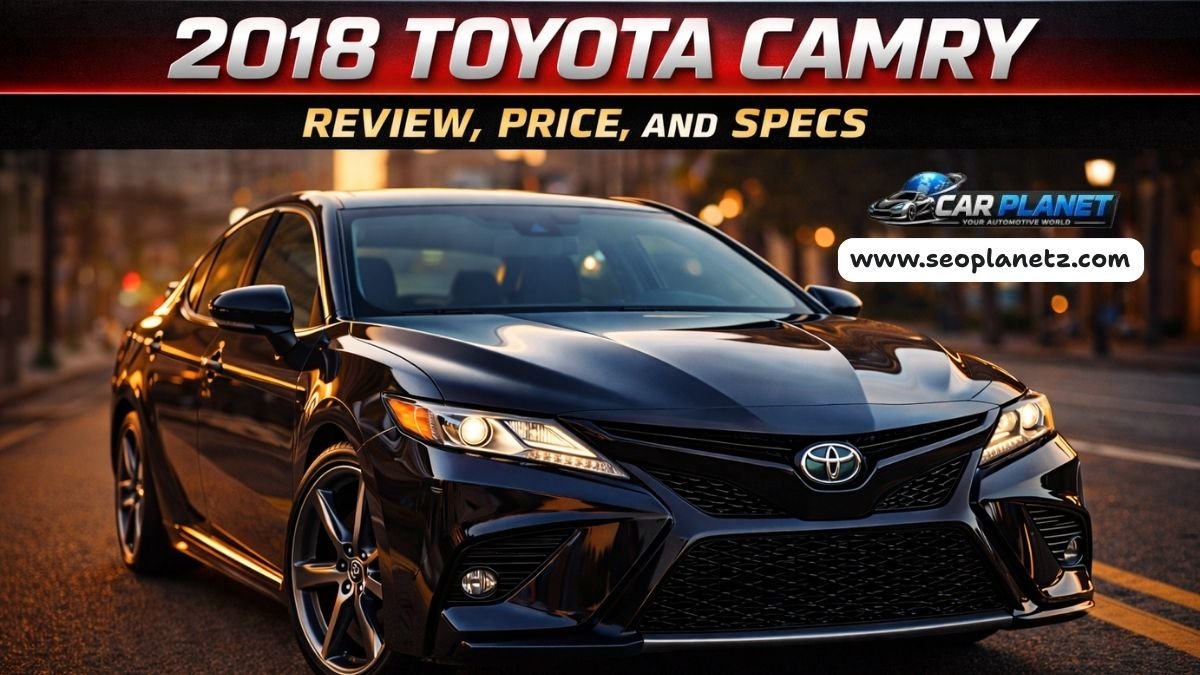
The 2018 Toyota Camry arrived as one of the most dramatic reinventions in Toyota’s history, ditching its “boring but reliable” reputation for a genuinely exciting sedan that could compete on style, performance, and technology. If you’ve been considering buying or researching a used midsize sedan, the 2018 Toyota Camry deserves a very serious look.
This guide covers everything you need to know — from engine specs and interior features to pricing, reliability data, and real-world fuel economy. Whether you’re shopping the used market or just want to understand what makes this generation special, you’ll find the answers here.
What Makes the 2018 Toyota Camry Different?
Toyota completely redesigned the Camry for 2018, building it on the new TNGA (Toyota New Global Architecture) platform. This wasn’t a refresh — it was a ground-up rebuild.
The result was lower ride height, a wider stance, a stiffer body structure, and far more engaging driving dynamics. Critics who had called previous Camrys appliance-like transportation were genuinely surprised by how the 2018 model drove.
Toyota also made bold styling choices with sharp creases, an aggressive grille, and a fastback-inspired roofline. Love it or hate it, nobody was calling it boring anymore.
Also Read: How to Used Toyota RAV4 Complete Buyer’s Guide 2026
2018 Toyota Camry Specs: Engine and Performance
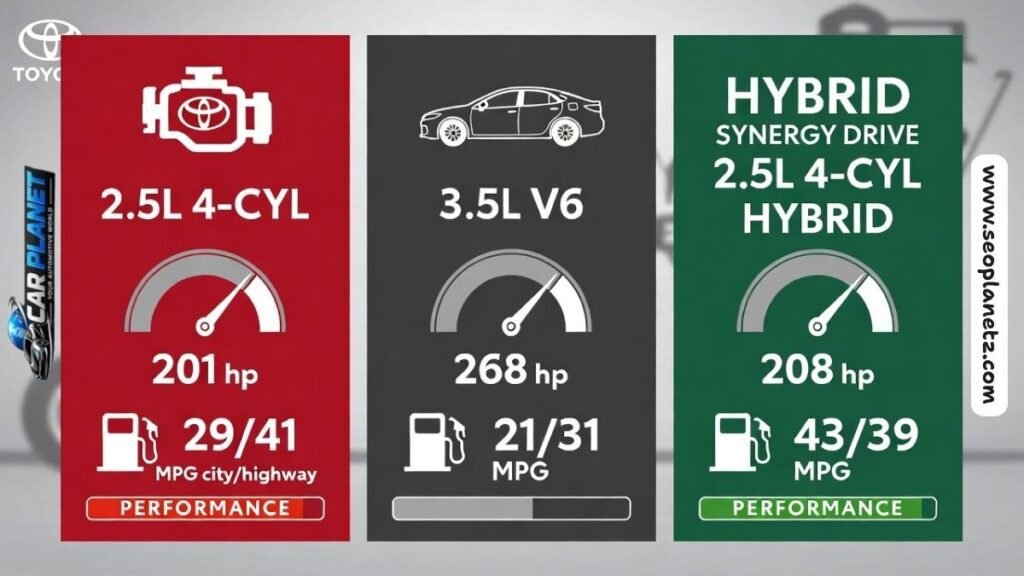
The 2018 Toyota Camry specs offer three powertrain options, giving buyers a genuine choice between efficiency, performance, and hybrid savings.
2.5L Four-Cylinder (Base Engine)
The standard engine is a 2.5-liter Dynamic Force four-cylinder producing 203 horsepower and 184 lb-ft of torque. It’s paired with a new Direct-Shift 8-speed automatic transmission.
This engine is quick enough for daily driving, merging confidently onto highways and passing without hesitation. Most buyers opt for this engine and are completely satisfied.
3.5L V6 Engine
The optional V6 delivers 301 horsepower and 267 lb-ft of torque — genuinely quick numbers for a family sedan. The 0-60 mph time of around 5.7 seconds puts it in sports sedan territory.
If you want the most engaging driving experience in a 2018 Toyota Camry, the V6 trim (XSE V6 or XLE V6) is worth the premium.
Also Read: How Long Do Car Batteries Last? 7 Critical Facts
Hybrid Powertrain
The 2018 Toyota Camry Hybrid uses a 2.5L Atkinson-cycle engine paired with Toyota’s proven hybrid system, producing a combined 208 horsepower. Its real strength is fuel economy, which we’ll cover in detail below.
| Specification | 2.5L 4-Cylinder | 3.5L V6 | Hybrid |
|---|---|---|---|
| Horsepower | 203 hp | 301 hp | 208 hp (combined) |
| Torque | 184 lb-ft | 267 lb-ft | 163 lb-ft |
| Transmission | 8-speed auto | 8-speed auto | CVT |
| 0-60 mph | ~7.6 sec | ~5.7 sec | ~7.4 sec |
| Drive Type | FWD | FWD | FWD |
Source: Toyota Motor Corporation official specifications
2018 Toyota Camry Fuel Economy
Fuel economy is one of the strongest arguments for choosing the 2018 Toyota Camry, especially in hybrid form. The EPA ratings across all variants are competitive for the midsize sedan class.
Fuel Economy by Trim
The 2.5L four-cylinder achieves 29 mpg city / 41 mpg highway / 34 mpg combined — excellent numbers for a non-hybrid. The V6 drops to 22 city / 33 highway / 26 combined, which is the trade-off for 301 horsepower.
The Hybrid is the real standout, rated at 51 city / 53 highway / 52 combined. That’s exceptional for a full-size family sedan and approaches small hybrid territory.
Real-World Numbers
Consumer reports and owner surveys suggest real-world fuel economy tracks closely with EPA estimates for this generation of Camry. The TNGA platform’s improved aerodynamics and the more efficient transmissions both contribute to strong on-road efficiency.
According to the U.S. Department of Energy’s fueleconomy.gov, the 2018 Camry Hybrid is one of the top-rated non-plug-in hybrids in its class.
Also Read: 2017 Honda Civic Review, Price, and Specs
2018 Toyota Camry Price in USA: New vs. Used Market
When new, the 2018 Toyota Camry price in USA ranged from approximately $23,495 for the base L trim to $35,650 for the fully loaded XSE V6. The Hybrid SE started around $27,800.
As of 2024-2025, the used market has settled considerably. Here’s a realistic pricing breakdown based on current used car market data:
| Trim Level | Original MSRP | Typical Used Price (2024-25) |
|---|---|---|
| L (Base) | $23,495 | $17,000 – $20,500 |
| LE | $24,895 | $18,000 – $22,000 |
| SE | $25,995 | $19,500 – $23,500 |
| XLE | $29,450 | $21,000 – $26,000 |
| XSE V6 | $34,950 | $24,000 – $30,000 |
| Hybrid SE | $27,800 | $20,000 – $25,000 |
| Hybrid XLE | $32,250 | $23,000 – $28,000 |
Prices vary based on mileage, condition, location, and history. Data sourced from Kelley Blue Book and Edmunds market trends.
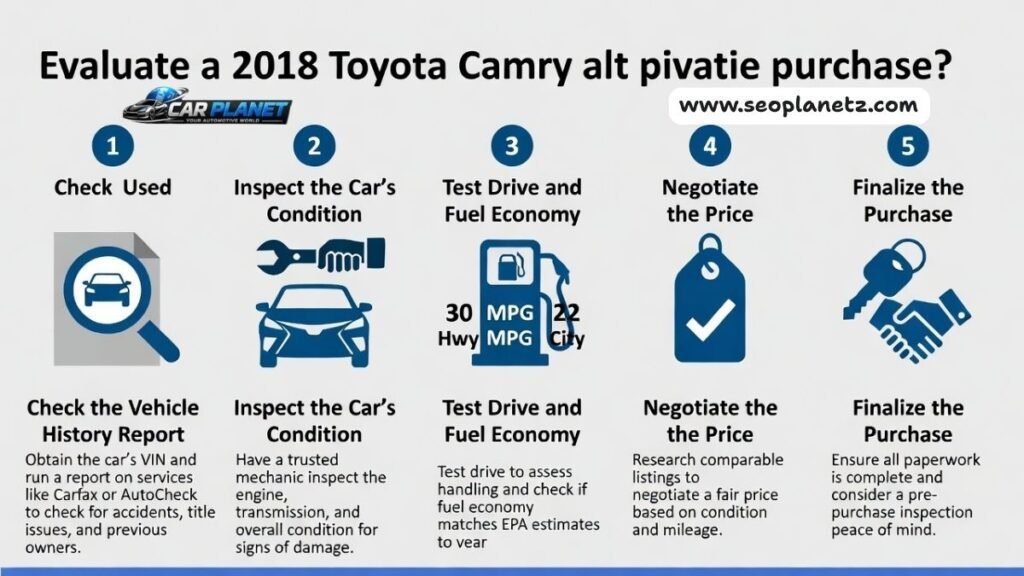
Mileage matters significantly. A well-maintained 2018 Camry with under 60,000 miles will command a premium over a high-mileage example. Always check vehicle history through Carfax or AutoCheck before purchasing.
2018 Toyota Camry Interior Features
The interior of the 2018 Toyota Camry was another major area of improvement over its predecessor. Toyota invested heavily in materials, technology, and design.
Standard Features Across All Trims
Even the base L trim came with Toyota Safety Sense P (TSS-P) as standard equipment — a notable decision that included pre-collision warning, automatic emergency braking, lane departure alert, and adaptive cruise control. This was ahead of many competitors who charged extra for these features.
The 7-inch touchscreen with Apple CarPlay (added mid-cycle) and Android Auto compatibility made the infotainment system practical and modern. The standard 6-speaker audio system is adequate, while upper trims get a JBL premium system.
Also Read: How Long Do Car Batteries Last? 7 Critical Facts You Need to Know
Upper Trim Interior Upgrades
The XLE and XSE trims add genuine leather seating, heated and ventilated front seats, a panoramic moonroof, wireless phone charging, a head-up display, and a 10-way power driver’s seat.
The XSE gets sport-specific interior touches including a flat-bottom steering wheel, sport pedals, and unique seat bolstering. It’s the most driver-focused interior in the lineup.
Rear Seat Space
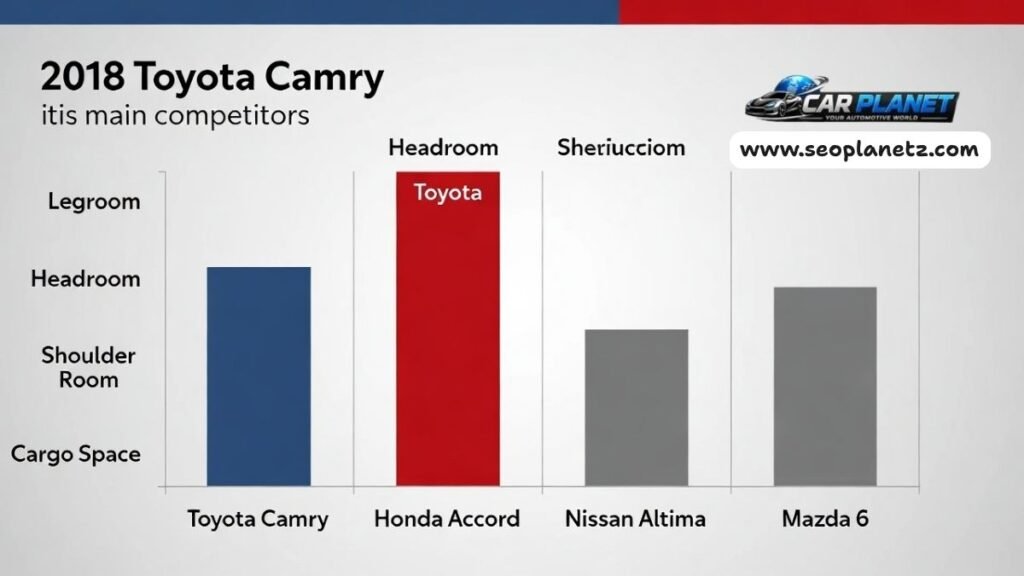
The 2018 Toyota Camry interior offers 38.9 inches of rear legroom, which is excellent for a midsize sedan. Adult passengers sit comfortably on longer trips, and the rear-seat usability is a major practical advantage over smaller competitors.
2018 Toyota Camry Trim Levels Explained
The 2018 Toyota Camry launched with seven trim levels for the standard model and four for the Hybrid. Understanding the differences helps you find the best value.
L — The entry point. Rarely found on dealer lots, primarily for fleet sales. Misses some convenience features.
LE — The most popular trim. Adds automatic climate control, a backup camera, and a more complete feature set. Excellent value.
SE — Sport appearance package with larger wheels, sport tuned suspension, and unique exterior styling. Same mechanicals as LE.
XLE — Luxury-focused. Adds leather, wood-grain trim, navigation, and premium comfort features. The relaxed cruiser of the lineup.
XSE — Sport + luxury combination. Aggressive styling with the V6 available. The enthusiast’s choice.
TRD (added later) — Track-inspired appearance package, not available in 2018 model year. Skip this for now.
2018 Toyota Camry Problems and Reliability
The 2018 Toyota Camry has a strong reliability record, but no vehicle is perfect. Understanding the known issues helps you make a smarter purchase.
Common Reported Issues
The most frequently reported 2018 Toyota Camry problems include minor infotainment glitches with the touchscreen freezing or resetting. This was addressed with software updates and is largely resolved on vehicles that have been to dealers.
Some owners reported wind noise from door seals, particularly at highway speeds. This is typically a simple weatherstripping fix rather than a structural concern.
A small percentage of 2.5L engine owners reported oil consumption slightly above normal, though Toyota issued a technical service bulletin (TSB) addressing this on early production units.
Also Read: 2020 Hyundai Elantra Review, Price, and Specs
Reliability Scores
The 2018 Toyota Camry scores well across major reliability indices. J.D. Power gave it above-average marks, and Consumer Reports rates it highly for predicted reliability based on owner survey data.
According to NHTSA’s vehicle safety database, the 2018 Camry has a 5-star overall safety rating — the highest available. It also earned Top Safety Pick+ from the IIHS, one of the industry’s most rigorous standards.
This reliability track record is one of the main reasons the 2018 Toyota Camry remains a smart used car buy in 2025.
How the 2018 Camry Compares to Key Rivals
The midsize sedan segment is competitive, and the 2018 Toyota Camry wasn’t the only strong option that year. Here’s how it stacked up against its main rivals.
| Feature | 2018 Camry LE | 2018 Honda Accord LX | 2018 Mazda 6 Sport |
|---|---|---|---|
| Starting Price | $24,895 | $23,720 | $22,995 |
| Horsepower | 203 hp | 192 hp | 187 hp |
| Fuel Economy (combined) | 34 mpg | 32 mpg | 30 mpg |
| Safety Sense (Standard) | Yes | Yes | No |
| Rear Legroom | 38.9 in | 40.4 in | 38.5 in |
| Cargo Space | 15.1 cu ft | 15.8 cu ft | 14.8 cu ft |
| Predicted Reliability | Above Avg | Above Avg | Above Avg |
Data sourced from manufacturer specifications and EPA ratings. Prices reflect original MSRP.
The Honda Accord offers slightly more rear legroom and cargo space, while the Mazda 6 provides a more premium interior feel at a lower price point. However, the Camry’s standard safety technology package and stronger resale value give it a competitive edge in most buying scenarios.
Per Edmunds expert reviews, the 2018 Camry is among the top-recommended used midsize sedans in the $20,000–$25,000 range.
2018 Toyota Camry Safety Ratings
Safety is one of the most compelling arguments for the 2018 Toyota Camry. Toyota made a bold decision to include their Toyota Safety Sense P package as standard equipment on every single trim — even the base model.
This suite includes automatic emergency braking, pedestrian detection, lane departure alert with steering assist, and radar cruise control. Many competing brands charged $1,000–$2,000 as an add-on for similar packages in 2018.
The NHTSA awarded the 2018 Camry 5 stars in overall crash protection. The IIHS rated it Good (the highest score) in all crash categories and awarded Top Safety Pick+ status.
For families or new drivers especially, the 2018 Toyota Camry’s safety credentials are hard to beat at its current used price points.
Resale Value and Long-Term Ownership Costs
One of the underappreciated strengths of the 2018 Toyota Camry is how well it holds its value. Compared to domestic competitors and even some Japanese rivals, the Camry’s depreciation curve is favorable.
KBB’s 5-year cost-to-own data consistently places the Camry near the top of its segment for total ownership economics — factoring in fuel, insurance, maintenance, and depreciation. According to Kelley Blue Book’s research center, Toyota holds the highest brand resale value in its segment.
Routine maintenance costs are also reasonable. Oil changes, brake service, and tire rotations are the main expenses during normal ownership. The 2.5L engine in particular has a long track record of reliability with proper maintenance intervals followed.
Also Read: Why Is My Car Smoking? 7 Common Causes and How to Fix Them
Key Takeaways
Before we wrap up, here’s a quick summary of what makes the 2018 Toyota Camry stand out:
- The 2018 redesign transformed the Camry from a conservative choice to a genuinely competitive, stylish sedan worth considering
- Three powertrains (four-cylinder, V6, Hybrid) offer flexibility for different priorities and budgets
- Standard Toyota Safety Sense across all trims was a class-leading decision in 2018
- The Hybrid variant’s 52 mpg combined rating is exceptional for a non-plug-in family sedan
- Current used market pricing puts the 2018 Toyota Camry in the $17,000–$30,000 range depending on trim and mileage
- Reliability ratings from NHTSA, IIHS, J.D. Power, and Consumer Reports are all strong
- Known issues are minor and largely resolved through software updates or simple fixes
Frequently Asked Questions
Q: How much should a 2018 Toyota Camry cost?
In the current used market (2024-2025), a 2018 Toyota Camry typically costs between $17,000 and $26,000 depending on trim level, mileage, and condition. Base LE trims with 60,000–80,000 miles average around $19,000–$21,000. V6 and Hybrid variants command higher prices.
Q: Is the 2018 Toyota Camry a good car to buy?
Yes — the 2018 Toyota Camry is widely considered one of the best used midsize sedans available today. It earns strong marks from J.D. Power, Consumer Reports, NHTSA (5 stars), and IIHS (Top Safety Pick+). The standard safety technology, fuel efficiency, and Toyota’s proven reliability make it an excellent choice.
Q: How many miles is a 2018 Toyota Camry good for?
With proper maintenance, a 2018 Toyota Camry can reliably reach 200,000 to 300,000 miles. Toyota’s engines are among the most durable in the industry, and the TNGA platform was designed with long-term reliability in mind. Regular oil changes and following the maintenance schedule are the most important factors.
Q: What’s a good year to buy a Toyota Camry?
The 2018 model year is considered one of the best Camry years ever produced because it represented a complete ground-up redesign with modern safety technology, improved driving dynamics, and a fresh interior. Other strong years include 2019-2021 (which share the same platform) and 1997-2001 (the legendary V6 era). For current used car buyers, 2018-2021 offers the best combination of technology, safety, and value.
Q: What are the most common 2018 Toyota Camry problems to watch for?
The most common issues include infotainment screen freezing (fixable with software updates), minor wind noise from door seals, and slightly elevated oil consumption on early 2.5L engines. None of these are major mechanical concerns, and most have been addressed through dealer service bulletins.
Q: How does the 2018 Camry Hybrid compare to the standard model?
The 2018 Toyota Camry Hybrid achieves 52 mpg combined versus 34 mpg for the four-cylinder — a significant difference for high-mileage drivers. The Hybrid carries a price premium of roughly $3,000–$4,000 used, which can be recovered through fuel savings over 3-5 years of typical driving.
Q: Does the 2018 Toyota Camry require premium fuel?
No. The 2018 Toyota Camry runs on regular 87-octane fuel in both four-cylinder and V6 versions. The Hybrid also uses regular unleaded. This keeps operating costs lower than luxury competitors that require premium fuel.
Also Read: How to Jump a Car Safely and Correctly in 2026
Conclusion
The 2018 Toyota Camry represents a genuine turning point for one of the world’s best-selling sedans. Toyota didn’t just update the Camry for 2018 — they rebuilt it with sharper styling, a stiffer and sportier platform, more powerful engines, and class-leading standard safety technology.
For used car buyers, the 2018 Toyota Camry hits a sweet spot. It’s new enough to offer modern technology and connectivity, yet old enough to have depreciated to very accessible price points. The strong reliability record means you’re unlikely to face major mechanical surprises, and the parts and service network for Toyota vehicles is as widespread as it gets.
Whether you prioritize fuel economy (go Hybrid), performance (choose the V6 XSE), or everyday practicality (LE or SE four-cylinder), the 2018 Toyota Camry delivers a version that fits your needs. It earns its reputation as one of the smartest used car buys in the midsize segment.
If you’re seriously shopping, use the pricing table above as your benchmark, verify history through Carfax, and budget for an independent pre-purchase inspection. The 2018 Toyota Camry is built to last — and with the right example, it can serve you well for another 100,000 miles or more.